ShopDreamUp AI ArtDreamUp
Deviation Actions





Description
2012, acrylics, digital & photography
ca. 125,000,000 years ago, Early Cretaceous (early Aptian), San Remo, (87 km southeast of Melbourne), Victoria, Australia.
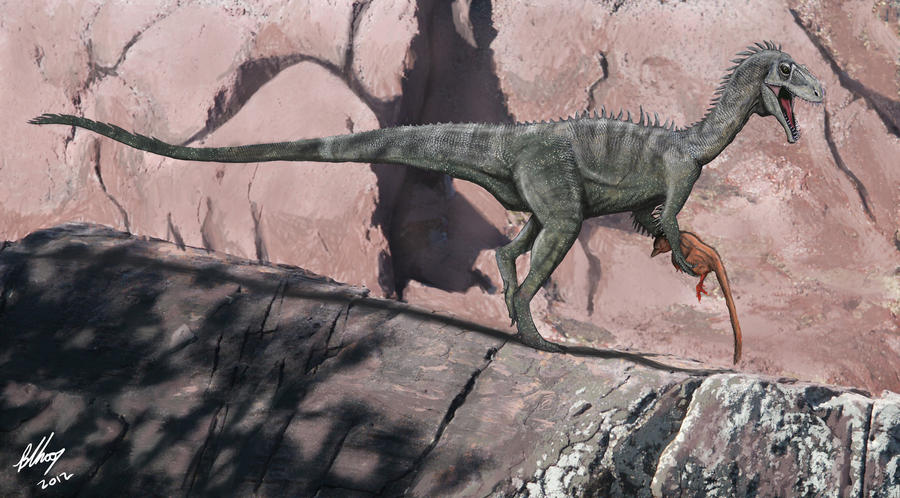
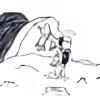
Under the 24-hour sunlight of the south polar summer, a 2.5 metre long ceratosaurian theropod hisses at a potential threat as she slinks back to her lair after a hunting foray. Grasped in her foreclaws is a dromaeosaurid chick.
This is a largely hypothetical reconstruction, based on an isolated astragalocalcaneum (NMV P221202) from the Early Cretaceous Wonthaggi Formation at San Remo, Victoria. Although only 6 cm wide, this fragment provides sufficient anatomical data to provide the first unambiguous evidence for an Australian ceratosaur.
In addition to the astragalocalcaneum, I've also incorporated a few other bits and pieces of fragmentary Victorian theropod - including some Masiakasaurus-like teeth from Flat Rocks. The end result is a sort of generalised "proto-Masiakasaur". The presence of dromaeosaurs in EK Victoria is based on isolated teeth.
REFERENCE
Fitzgerald EM, Carrano MT, Holland T, Wagstaff BE, Pickering D, Rich TH, Vickers-Rich P. (2012) First ceratosaurian dinosaur from Australia. Naturwissenschaften. 2012 May 3. [Epub ahead of print]
copyright 2012, Brian Choo
ca. 125,000,000 years ago, Early Cretaceous (early Aptian), San Remo, (87 km southeast of Melbourne), Victoria, Australia.
Under the 24-hour sunlight of the south polar summer, a 2.5 metre long ceratosaurian theropod hisses at a potential threat as she slinks back to her lair after a hunting foray. Grasped in her foreclaws is a dromaeosaurid chick.
This is a largely hypothetical reconstruction, based on an isolated astragalocalcaneum (NMV P221202) from the Early Cretaceous Wonthaggi Formation at San Remo, Victoria. Although only 6 cm wide, this fragment provides sufficient anatomical data to provide the first unambiguous evidence for an Australian ceratosaur.
In addition to the astragalocalcaneum, I've also incorporated a few other bits and pieces of fragmentary Victorian theropod - including some Masiakasaurus-like teeth from Flat Rocks. The end result is a sort of generalised "proto-Masiakasaur". The presence of dromaeosaurs in EK Victoria is based on isolated teeth.
REFERENCE
Fitzgerald EM, Carrano MT, Holland T, Wagstaff BE, Pickering D, Rich TH, Vickers-Rich P. (2012) First ceratosaurian dinosaur from Australia. Naturwissenschaften. 2012 May 3. [Epub ahead of print]
copyright 2012, Brian Choo
Image size
2362x1306px 814.15 KB
Make
Minolta Co., Ltd.
Model
DiMAGE 7
Shutter Speed
1/180 second
Aperture
F/6.7
Focal Length
49 mm
ISO Speed
100
Date Taken
Jan 31, 2007, 2:11:08 PM
© 2012 - 2024 Gogosardina
Comments41
Join the community to add your comment. Already a deviant? Log In
 it is fantastic job !!!